
Most people who grind their teeth at night don’t know they’re doing it. Here’s how to tell, what makes it worse, and the steps that actually help protect your teeth.
By the FixUrSmile Dental Lab team · Updated September 2026
According to Mayo Clinic, common signs of bruxism include grinding loud enough to wake a partner, worn or chipped teeth, tooth sensitivity, tired or tight jaw muscles, jaw or face pain, and a dull morning headache near the temples. Your dentist may also spot flattened or worn tooth surfaces.
There’s no single cause. Sleep bruxism is linked to brief sleep disturbances, stress and anxiety, caffeine, alcohol, tobacco, some medications, sleep disorders such as sleep apnea, and family history. That’s why the best approach usually combines protecting your teeth with reducing the triggers.
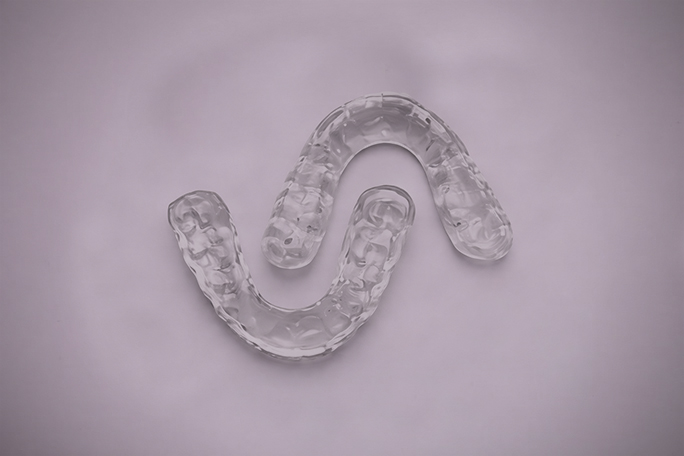
A night guard doesn’t cure grinding, but according to Mayo Clinic, splints and mouth guards keep the upper and lower teeth separated during sleep, so the guard takes the wear instead of your enamel. It’s often the first thing dentists recommend. Compare types in best night guard for teeth grinding.
Stress and anxiety are strongly linked to grinding and clenching. A consistent wind-down routine, exercise earlier in the day, stretching, breathing exercises, or meditation can help. If anxiety is ongoing, talking with a professional can help too.
Caffeine and alcohol are both linked to more grinding. Try avoiding caffeine in the afternoon and limiting alcohol in the evening.
Tobacco use is associated with a higher risk of bruxism, along with many other oral health problems.
Keep a regular sleep schedule, a cool dark room, and screens off before bed. If you snore loudly, wake up gasping, or feel tired despite a full night, ask a doctor about sleep apnea, which is associated with grinding.
Daytime clenching can carry into the night. Practice “lips together, teeth apart” with your tongue resting behind your front teeth, and avoid chewing gum or pens, which keep jaw muscles working. See jaw clenching.
Warmth on the jaw muscles before bed and gentle jaw stretches can ease tension. Stop if anything causes pain.
Some medications, including certain antidepressants, are linked to grinding. Don’t stop any medication on your own; ask your doctor whether it could be a factor.
Your dentist can check for tooth wear, cracks, and damage to fillings, and can help rule out bite or jaw problems. If you have jaw pain or locking, see night guard for TMJ.
| Type | Typical cost* | Notes |
|---|---|---|
| Boil-and-bite (store-bought) | About $20–$30 | Generic fit, often bulky |
| Custom from an online lab | About $50–$200 | Made from your impressions |
| Custom from a dentist | About $300–$1,000 | Made from in-office impressions |
*As reported by GoodRx.
A FixUrSmile custom night guard is $297 per arch, made in our US dental lab from impressions you take at home. Unsure about fit or which arch? See how a night guard should fit and upper or lower night guard.
Some people reduce grinding a lot by addressing triggers like stress, caffeine, alcohol, and sleep problems. For many, grinding doesn’t stop entirely, so a night guard protects the teeth.
Not exactly. It protects your teeth from the damage of grinding by taking the wear instead of your enamel.
There’s no single proven cause. Bruxism is linked to stress, sleep disturbances, certain substances and medications, and genetics. Ask your doctor if you have other symptoms.
If your teeth are worn, chipped, or sensitive, or you have jaw pain, headaches, or a jaw that locks or clicks.
Custom night guard from your impressions, $297 per arch. Made in our US dental lab from impressions you take at home, with licensed dentist approval and our Custom Fit Guarantee.
What flexible dentures are, how they compare to acrylic and metal partials, what they cost, how long they last, and how …
A flipper tooth is a removable partial that replaces one or a few missing teeth. Learn what it costs, how long it lasts,…
Partial dentures cost about $300 to $2,500 at a dental office. Compare prices for acrylic, flexible, metal, and flipper …