
The material in your denture affects how it looks, feels, lasts, and what it costs. Here’s a plain-English guide to each one.
By the FixUrSmile Dental Lab team · Updated September 2026
Every denture or partial has two parts: the base, which sits on your gums and holds everything together, and the teeth, which replace the missing ones. Partials also have a way to grip your natural teeth, such as wire clasps or flexible gum-colored extensions.
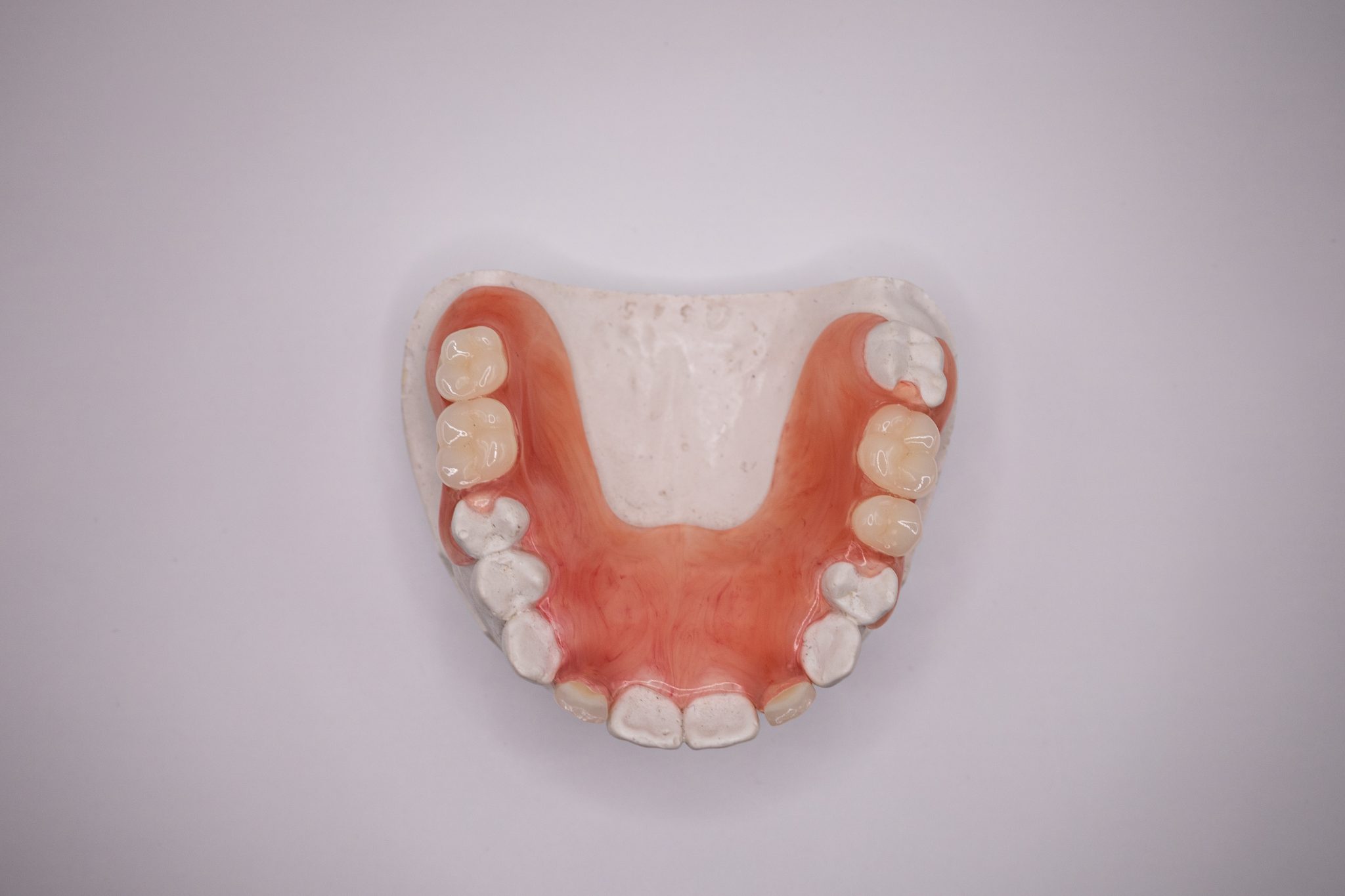
| Material | What it’s like | Used in |
|---|---|---|
| Acrylic resin (PMMA) | Rigid, pink, easy to adjust and repair | Full dentures, acrylic partials, flippers |
| Flexible thermoplastic (nylon-type resin) | Thin, bendable, metal-free | Flexible partials, Nesbit partials |
| Cast metal (often cobalt-chromium) | Strong, thin framework | Cast metal partials made by dentists |
Acrylic partials typically use small stainless steel wire clasps. Flexible partials use gum-colored extensions of the base instead of metal, which is why they’re popular when people want partial dentures without visible metal.
Material is one of the biggest cost drivers. At a dental office, flexible partials typically run about $900–$2,000 and cast metal about $650–$2,500, according to Guardian Life. FixUrSmile acrylic partials start at $245 and flexible partials at $315.
Full routine: how to clean partial dentures.
Most dentures use an acrylic resin base with acrylic resin teeth. Many partials use flexible nylon-type resin or a cast metal framework instead.
They’re made of a thermoplastic, nylon-type resin that is thin and slightly flexible.
Some do. Acrylic partials often have wire clasps and cast partials have a metal framework. Flexible partials are metal-free.
Cast metal frameworks are very durable, while acrylic is easiest to repair. Lifespan also depends heavily on care and changes in your mouth.
Acrylic from $245, flexible from $315, Nesbit $260. Made in our US dental lab from impressions you take at home, with licensed dentist approval and our Custom Fit Guarantee.
Why you clench your jaw, the signs to watch for, how it affects your teeth and jaw, and practical ways to reduce clenchi…
How a night guard should feel when it fits correctly, signs it's too tight or too loose, what's normal in the first week…
Should your night guard go on your upper or lower teeth? Compare comfort, fit, speech, and durability, and learn when a …